
Why are Gorillas Poached?
Why are gorillas poached? You could be wondering as to why gorillas are poached. In this article, I bring you some of the reasons as to why poachers poach gorillas. First and foremost, gorillas are termed apes that usually inhabit forested areas.
We have only 2 species of gorillas in the wild, including western gorillas and eastern gorillas. Eastern gorillas are then subdivided into 4 subspecies, including mountain gorillas that usually thrill in the mountainous parts of Africa within the East African region (Uganda, Rwanda and Congo); eastern lowland gorillas residing in the Democratic Republic of Congo; and western lowland gorillas found in western parts of Africa. Both Eastern lowland and western lowland Gorilla prefer to inhabit areas of low elevation like swamps, marshes, etc.
Of all the 4 subspecies of eastern gorillas, mountain gorillas greatly experienced a great attack and were almost at a point of total extinction in the wild by the 19th century when less than 1000 gorillas were remaining in the wild, most especially due to poaching, though their population is slightly increasing to over 1000 gorillas thriving in the wild, probably due to conservation plans put in place and creating awareness about the need to preserve these endangered primates in their natural habitats in 3 destinations, including Uganda, the pearl of Africa; Rwanda, the land of a thousand hills; and the Democratic Republic of Congo.
In Uganda, mountain gorillas are trekked in 2 beautiful parks: Bwindi Impenetrable National Park, a home to the largest population of mountain gorillas, as well as Mgahinga Gorilla National Park, a home to only 1 Nyakagezi gorilla family.
While in Rwanda, mountain gorillas are trekked in Volcanoes National Park, and in Congo, mountain gorillas are trekked in Virunga National Park. However, the Democratic Republic of Congo is blessed to have the other species of gorillas, Eastern Lowland gorillas, that are found in Kahuzi-Biega National Park.
Some of the reasons as to why gorillas are poached include the need for food, traditional medicine, demand for bushmeat on the market, lack of awareness and many more.
Gorillas are also poached as a source of medicine, especially used by the traditional healers who believe that some of the body parts of the Gorillas like the head, feet and arms, are used to make charms and magic; thus, poachers end up killing the innocent primates to obtain those body parts and sell them off, hence collecting some cash.
Demand for bush meat: Gorillas have been poached and sold off as bush meat that is enjoyed mostly by the elites who feel like it’s so prestigious to have a taste of gorilla meat as bush meat. Some of the poachers enjoy poaching these gorillas in order to obtain the bush meat for themselves as well as their families, though sometimes these gorillas fall in traps set for other bush animals.
Taking an example of places like Bwindi Impenetrable National Park and Mgahinga Gorilla National Park that were habitats to both mountain gorillas and the Batwa people that only depended on hunting and gathering.
Just know that gorillas couldn’t escape the threat, as most of them were hunted down until the government of Uganda rose up and forcefully chased the Batwa out of the forest and also sensitized them about conservation, which saw a slight increase in the population of these gorillas once again, making Uganda the top destination with the largest population of endangered mountain gorillas for trekking and habituation experiences.
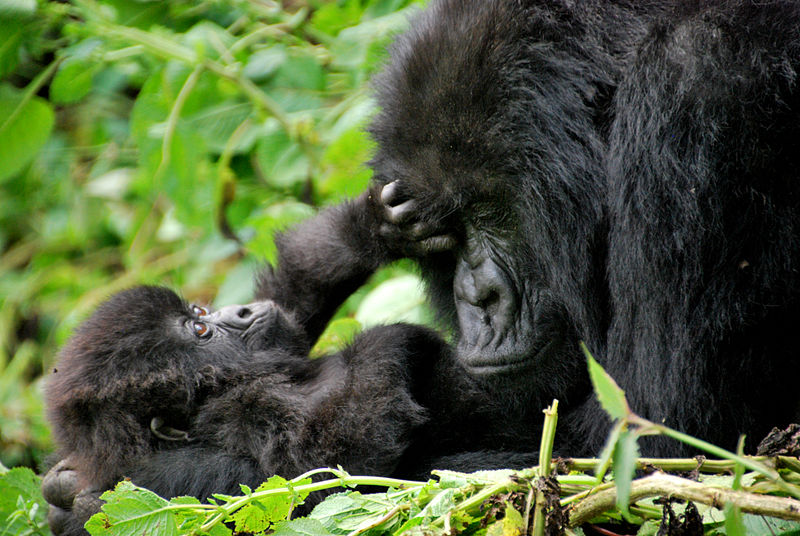
Yes, poaching has greatly been a threat to the population of gorillas, though there are other factors that affect these primates in their natural habitats, including loss of habitats by the increasing population and cutting off the forest to create land for agricultural purposes; diseases, especially human diseases like Ebola; political instabilities; and many more.
However, with the poaching and the other threats threatening mountain gorillas, you ought not to miss out on an adventurous safari to East Africa to spend an hour with these endangered mountain gorillas in Uganda, Rwanda and the Democratic Republic of Congo.
By 2026, a gorilla trekking permit in Uganda costs $800 for foreign nonresidents, $700 for foreign Residents and 300,000 Ugandan shillings for Ugandans and East Community member states. In Rwanda a gorilla trekking permit costs $1,500, making it the most expensive permit in East Africa, while in Congo it costs $400 during high season and $200 during low seasons.
Thus, the choice is yours whether to trek in Rwanda, Uganda or the Democratic Republic of Congo. At Achieve Global Safaris, we are ready to take you on a breathtaking gorilla trekking safari in any destination within East Africa.
