
Stone Town
Zanzibar isn’t just a spice island but a historical spotlight that once thrived in trade and civilization. This is truly represented in its capital, Stone Town, a World Heritage Site that blends Swahili vibes with the influences of Arabs, Portuguese, Persians, and Indians. You may struggle to see people from these cultures (maybe tourists), but their influence is evident in the architectural designs and door designs. Our Article below details the Stone Town.
In simple words, Stone Town is the capital of the Zanzibar Archipelago. However, this wonderful town has cultural and historical importance. The town was once a small fishing village named Shangani (if we trace the books and old traditions). No stone walls, just simple wooden walls and thatch roofs. Then came Arab traders and Persians on the island, who were once the richest. They built stone buildings using the same architecture from their favorite trading town, Kilwa.
By the 14th century, Stone Town had begun gaining popularity in Lisbon. As a result, the Portuguese invaded it and brought their European influence to this wonderful town. Their architecture is seen as up-to-date. And the spices? The Portuguese brought spices to Zanzibar. But Arab rulers fought back to regain their influence on this island. By the 17th century, the town was once again Arab-run and the Sultan moved their residence to the Stone Town.

The Old Fort
Stone Town began building the best buildings we see today in the 1830s onwards. Soon after they defeated the Portuguese, they erected a thriving fort. This iconic building, Old Fort (or Ngome Kongwe), was built for military purposes. Today, the Old Fort is active and used to host events, including the Zanzibar International Film Festival (ZIFF) and the Sauti za Busara Festival. This landmark was built in 1699 and has been used for multiple purposes: a garrison, a prison, and a station for a railway station in Stone Town. As you stroll in the streets, take a stop at this iconic building to explore wonders, from the open-air amphitheater to curio shops selling souvenirs.
House of Wonders
Built in 1883, this building was once the best of all in Zanzibar. The records recognize it as the first building to have electricity and an elevator and hence the name “House of Wonders.” The building has had a turbulent past from the past to the present. The Anglo-Zanzibar war crushed it and led to massive destruction, hence losing its true beauty. Restorations made in 2020 also proved a failure, as the building collapsed again. At the time of writing, the House of Wonders is still under rehabilitation to restore and maintain its thriving appearance.
Palace Museum
Built on the site of another ‘ancient palace,’ this museum houses some of the best historical antiques. One of the captivating stories is about the history of Sayyida Salme, best known as Emily Ruete. She was an Arab princess who fled to Germany to start a new life with her husband, Rudolph Heinrich Ruete. Want her story? Salme was one of the 36 children of Sultan Said Ibn Sultan of Zanzibar. She is credited for her best work in writing, being the first Arab woman to publish a book (an autobiography, to be exact). You will find her book and other collections in this museum.
Forodhani Gardens
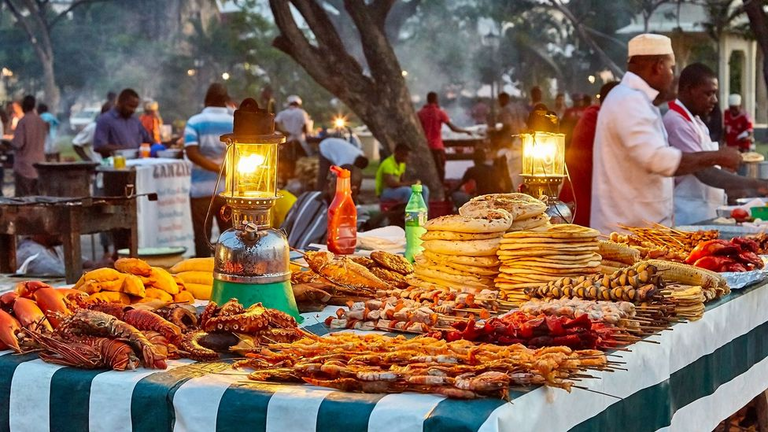
In front of two iconic buildings, Old Fort and House of Wonders, is a small park called Forodhani Garden. If you pass there during the day, the area may look quiet and peaceful. In the evening, this area transforms into a vibrant park, good for relaxing and witnessing sunsets. Here, local vendors and food sellers come to sell the best dishes of Zanzibar. You will find dishes like Zanzibar pizza, grilled seafood, and Urojo (Zanzibar Mix), among others. Walk with a local guide to help you pick the right food vendor, who prioritizes cleanliness and safety.
St. Joseph’s Cathedral
The majority of Zanzibaris are Muslims. Christianity also existed on this archipelago. In the 1860s, St. Joseph’s Cathedral was erected. This building is one of the famous landmarks in Zanzibar, towering high in the sky such that it is much easier to see it from a distance.
Other landmarks
If we were to mention all landmarks in Zanzibar, then this article would be extremely long. There’s much more to explore in this busy town. For instance, we haven’t named the Freddie Mercury House, Darajani Market, Former Slave Market, Tippu Tip’s House, Old Dispensary, and Shangani Street. If you still have free time, a boat cruise to Prison Island would be more interesting, as you will discover the giant Aldabra tortoises and old prison.
Stone Town is the vibrant town famous for its spectacular rich culture and historic landmarks. No Holidays to Zanzibar beaches are complete without losing yourself in the maze-like streets of historic Stone Town. Plus, we are here to help you through the planning process.
